Saturday, April 19, 2025

The Lost Continent Of Kumari Kandam


There are many ancient accounts of lost continents and mythical kingdoms that have stirred the imagination of ancient bards and modern storytellers, as well as inspire archeologists and historians to seek the truth of supposedly lost civilizations. Atlantis, once described by the Greek scholar Plato remains a popular topic to research and study, as was the legendary Nordic tale of Thule. When the subject of lost civilizations comes up, there is mention of the fabled Shangri La, Xanadu and legendary cities such as Anau in Central Asia. Spanish Conquistadors sought the Fountain Of Youth and the City of Gold where a Native king daily covered himself in gold dust then jumped into a river to wash himself, leaving a golden hue to the river which was reflected by the light of the Sun. The Aztecs believed their ancestral home to be Aztlan, a name remarkably similar to Atlantis. Some have translated the name from Nahuatl to mean place of herons, place of whiteness or place of reeds; all these indicate a possible watery connection. These stories may reflect some long lost memory of a people or fantasy that has either found its way into the folklore of a nation, are the basis of a people's foundational beliefs, or these accounts may retain some ancient truth of an actual kingdom that once actually existed. It is through such stories that the historian, the archeologist and the author of fantasy novels find common ground- the stories exist, and the question is why. 


Just as it was theorized that before the ocean swallowed Atlantis, the continent acted as a land bridge which connected Europe, Africa and what become later known as the Americas, so was a theory put forth by the 19th century zoologist and scholar Philip Sclater, who proposed that a continent lay submerged under the Indian Ocean which he named Lemuria. He cited the lemurs, which are a variety of animal found on the island of Madagascar off of eastern Africa, as an example of migration to India via this lost land bridge. The theory that there was such a continent however was discredited in the 20th century due to the study of plate tectonics and the study of continental drift. Likewise did one John Churchward label another lost continent in the Pacific which he called Mu. The founder of theosophy Helena Blavatsky ventured further to claim that humanity began on Lemuria, influencing esotericism and other occultist schools of thought. 

This interest in lost kingdoms and land masses was nonetheless stimulated by the myths and stories told and recounted over the centuries by various peoples. The efforts of Heinich Schliemann led to the discovery and exploration of ancient Troy. Through the fabled voyage of the Kon Tiki did Thor Heyerdahl attempt to prove that ancient mariners sailed the Pacific from South America in boats made of balsa logs and reeds, a design based on the accounts of the ancient Incans themselves, using the technology of their time. The Norwegian adventurer believed a fair haired Caucasian people he called the Tiki ventured forth into the Pacific before the Polynesians did. Similarly did Kurt Von Danniken propose that aliens visited the Earth and passed on knowledge to humans, citing such examples as the famous Nazca Lines in Peru which when viewed from above seemingly can only make sense if viewed from space. These theories have been dismissed but some scholars are investigating still, believing that there is some truth behind the theories. It has been determined that 50,000 years ago  Australia and New Guinea were connected due to lower sea levels, allowing for easy migration from southern Asia for groups of migrating people. Did the Aborigines perhaps come to Australia using a similar land bridge between Africa and the South Pacific during what they call their Dream Time, when the Australian desert outback was lush with lakes and rivers as their myths imply? Surely, folk tales have stimulated the minds of many and continue to do so. 


I
n Tamil literature there is mention of Kumari Kadam, a mythical sunken land mass that was once home to a great advanced civilization. Indeed the idea that civilization rose from the sea is ancient, as the Sumerians believed that all life began when dry land emerged from the the Apsu, the fathomless eternal sea. Sumer, located in what is today Iraq, was connected to the Persian Gulf which further connected to the Indian Ocean. There are recorded trade interactions between Harappa and the Indus valley civilization with Sumer in the Bronze Age. The folk tales of Oman and Yemen suggest a great land in the ocean which sank long before their own rise in the ancient era. The trade route culture of the dhow boats of the Persian Gulf cultures with India, Africa and the east are very old. Indonesian folklore tells of a sunken land in the Indian Ocean. In the Ramayana, the Indian epic which also became popular in Indonesia in ancient times, Ravana was a demon king of Lanka Island, the name seemingly associated with what is today Sri Lanka. On this island is a site on a mountain which boasts Adam's giant footprint, also a popular tale in Arabia, Oman and Yemen. In Khmer literature is mention of Mahendra Parvata, a lost city located deep in the jungle for which the famous Angkor Wat was modeled after, itself built deep in the Cambodian forest. While Western academics believed this to be a myth, natives actually have been making pilgrimages to the site for over a millennium. African cultures recount myths of lost cities or lands that emerged from the ocean depths. The Nyankole of Uganda tell of a mysterious city known as Zinga, swallowed by the Earth after a war with neighboring nations. Such tales as these shared by distant cultures seem to reflect the belief in the possibility of a common ancestral civilization. The historic trade routes whereby goods and spices traveled between African entities, such as between the Kingdom of Punt and the isles of Indonesia, are a living testament to this ancient past, as is the historical fact of the Tamils and the Chola Dynasty and the committed endeavor to control this ancient route, the spices plying the Indian Ocean eventually gracing the tables of wealthy Romans. The importance and lore of the Indian Ocean is as pertinent to the nations surrounding that ocean as the Mediterranean and Atlantic are for the nations of the West. 

The mystery of a possible sunken continent is fascinating enough for both academics and writers to draw inspiration from. Even if the theory is proven wrong, the human imagination will never tire of dreaming and fantasizing about this possibility. If academics cannot solve the questions and the puzzles that remain unaccounted for, at least the ancient bards and poets as well as modern storytellers should all be given credit for their attempt to make sense of those mysteries which scholars have yet failed to determine as fact. If Lemuria like Atlantis didn't actually exist in its physical form, it surely reigns still in the imagination of humanity, and likely will continue to do so. 


 Ismail Butera, 2025 


Saturday, September 21, 2024

The Maya, Mythology, Music & Me


As long as I can remember, I have always had an interest in the ancient world. As a child I would eagerly await Saturday mornings because on TV there were films about medieval heroes and villains, those Italian sword and sandal films featuring Steve Reeves as Hercules, famous epic films such as Ali Baba and the Forty Thieves, The Egyptian, The Last Days of Pompeii and many others. A Russian movie that for some reason was on every Saturday morning regularly known by its English title The Sword and the Dragon intrigued me with its depictions of magical beings and wizards, a famous wind demon and of course, the hero Ilya Murametz who rallies to defend his country against a horde of invaders and their fire breathing dragon, representing that universal theme of light and goodness against the forces of evil and darkness. Spartacus, Ben Hur, King of Kings, indeed any film that was set in some other time period was a fascination. I enjoyed these films which for me were entertainment. Yes, even the Wizard of Oz came in at a close second. Beyond these films there was Godzilla, King Kong, Rodan, The Mighty Behemoth, The Beast From 20,000 Fathoms, Mars The Angry Red Planet and It, The Terror From Beyond Space and other science fiction films. As I was very young, I didn't realize at the time that what was poking my interest were stories based on the cosmic battle between light and dark, good and evil. The hero of any of these tales were like the champions of old- a human being facing a challenge and figuring out how to overcome it, the detailed actions of the characters involved in the story. These films sparked an early interest in history and mythology and as soon as I learned to read and write I began to investigate and research on my own, exploring the background of the stories I watched on TV. 


By the time I was seven or eight years of age I became familiar with some cultural aspects, though via Hollywood, of ancient Egypt, Greece, and Rome as such films as Cleopatra and Quo Vadis informed my limited understanding of these civilizations. Alexander The Great, Atilla The Hun (with Anthony Quinn) and those 300 Hundred Spartans standing against superior Persian adversaries were badass for sure. Yet, this was at the time just entertainment for me. Never did I think I would follow the path of the historian or mythologist, nor did I dream that my later interest in music would one day reflect this inner fascination with the ancient or the traditional world. For that to occur and take place a spark was required that would prompt my lazy self to investigate and research a bit more seriously than merely being an avid watcher of epic films. 


Life Magazine and National Geographic was readily available in my home or in the homes of relatives, neighbors and friends. These magazines were known for the fine images included wthin their pages, captured by some of the greatest photographers of the day such as Ansel Adams, Alfred Stieglitz and John Mili, or the magazines might feature the work of early women pioneers such as Eliza R. Scidmore. This 8 year old kid enjoyed looking through these publications, fascinated by the beautiful images captured by the camera.


One day, I happened to open a magazine, LIFE if I recall, and within its pages were images that intrigued me. Ruins and tall monumental statuary that were uncovered from having been immersed in mud and earth for centuries, their discoverers standing next to or atop the monuments, completely dwarfed by their impressive size and height. Where were these images from? They seemed to me at the time to be somewhat Egyptian or maybe Babylonian but yet were very different and unique from anything I yet hereto beheld. I remember asking my Father if he knew where these giant artifacts were from and he responded rather matter of factly; "Mexico, Guatemala, the Yucatan". I began to wonder where the heck the Yucatan was. I knew about Mexico, as I sometimes  listened to the AM Spanish radio station and listened to Mariachi music on Sundays, but I made no association between Mexico and these ancient ruins. What I was about to uncover would change my life forever. I came across a film titled 'Kings Of The Sun' (with Richard Basehart, George Chakiris & Yul Brynner) of which I had no idea what it was about or where it took place, but I knew that the costuming was very ancient in style. I was again informed upon asking Dad that this was "a story about Indians", and wasn't taking place anywhere in the Middle East. What? In fact, I would learn years later that the film was about political turmoil and upheaval in a royal Mayan city that caused the ruling families to flee to what is now the southern coast of North America- a theory that has its roots in theoretical historical evidence. 


My Father traveled extensively in his younger days before he married my Mother, settled down and raised a family. To my surprise, I found out he did know Central America quite well, having visited many times while he was a trumpet player aboard Caribbean cruise ships. He knew the monuments I was looking at in the magazine as well as mentioning many other sites that boasted great pyramids and temples erected by a people who created a sophisticated civilization called the Maya. Covered by tropical forest overgrowth for centuries, explorers began to uncover the remains of a lost civilization in the jungles of Guatemala and the Yucatan. Following leads from the local natives who recounted stories of great kings and war lords who ruled the region before the arrival of the Spanish, and later perhaps due to the advent of the airplane from which one could look down while flying overhead and witness the tops of what seemed to be structures of palaces and pyramid like structures heretofore buried in the mud, interest in this region began in earnest as archeologists and historians rushed to find what was for them, a lost civilization. Just as the Conquistadors sought the fabled fountain of youth and legendary rivers of gold while satisfying their greed for this precious metal, so did the academic professors from prestigious universities around the world began to imagine a neo Utopian realm in the forests of Central America, a Mesoamerican Camelot or Shangrila. 


I understand why these Spanish adventurer conquerors were fascinated and drawn to the Mayan world, aside from their greedy desire for power, gold and converts. The locals are an interesting people, forced to speak Spanish and follow Roman Catholic ritual by their conquerors yet many continue to speak their native language and blend their ancient religious traditions with the Catholic rite. They wear colorful clothing, especially on feast days when they adore Mary 'Madre de Christo' but see her as the Earth goddess of their ancestors. Perhaps most fascinating about their rituals is one that has nothing to do with the imported religion and culture of Europe, that being the recording and calculating of time, an obsession that is a direct continuation of ancient Mayan religion. It is believed that when the last shaman known as 'the timekeeper' passes away and there are no more after him to maintain this all important task, all existence as we known and understand it will disappear, the heavens will melt and both men and the deities will have no meaning. This responsibility of maintaining the count of days was coined 'the burden of time' by the late scholar J. Eric S. Thompson. Indeed, Mayan cosmology and the unraveling and understanding of their complex mathematical system remains interesting and is further being examined as new discoveries are revealed about these fascinating people.  


Many of the amazing images I was exposed to as a curious child were photographed predominantly by the late great Alfred P. Maudslay (1850-1931) considered to be the father of Mesoamerican archeological photography. He encountered the newly excavated Mayan ruins at a place called Quirigua in Guatemala in 1881, and returned in 1883 for the purpose of documenting the archeological treasures uncovered at this site. His work is amazing- the monuments erected by once powerful kings were biographies of the great rulers, much like the monuments erected in ancient Egypt or the fertile Crescent, replete with self grandizing power and adoration, meant to inform friend and foe alike that this was a king of his domain who was to be taken seriously. These monuments were erected as part of a complex building initiative which took place at the height of Quirigua's power. The wonderful images captured by Alfred P. Maudsley were eventually bequeathed to the Pitt Rivers Museum in Oxford, Great Britain, but they were so widely shared around the world that this collection had come to be extremely popular among those interested in digging up the past, literally and figuratively. 


Workers at the Quirigua site are photographed dwarfed by the giant monuments, or are viewed standing on them, giving the sense of their grandeur, though in some of the photos these monuments are standing on a slant, for many were found on their sides buried under tons of mud and rubble, as if to reach desperately into the future to acknowledge the archeologists who found them, like an old soldier attempting to clumsily stand erect as in the days of his prime but age and the reality of time has taken its toll. These monuments reveal the story of a once glorious age, a brilliant civilization that dominated the jungles of Central America when the rest of the world had no clue what was actually happening there. Here was a culture that excelled in mathematics and in the calculation of time and the study of the heavenly bodies, having discovered the secret of zero independently of the old world. For me, here was a new world, no pun intended and I began to read and study the history of Central America. I became fascinated by the murals of Diego Rivera and other artists who depicted this glorious past in art. From such paintings I also became aware of the bloody conquest of Mexico and Central and South America by those intrepid Spanish Conquistadores, who boldly crossed an unchartered sea to conquer an empire, believing it was their God given duty to do so, the wages for this effort to be paid in gold, glory and the promise of a heavenly afterlife. The costumes of the region, perhaps the most colorful in the world like the imagery infiltrated my brain, and I couldn't help but see the relationship between costume and nature in these fashions. I would later learn how the Native view of the cosmos held that humanity and nature are one. Indeed, despite the terrible practice of human sacrifice which for a time was ignored by the early non Mayan scholastics who thought they discovered a perfect, super utopian and peaceful society in Central America but have since been proven wrong, as the Mayan city states warred with one another no differently than the ancient Greeks did with equal brutality and punishment reserved for the vanquished. The understanding of the universe remains a mystery requiring much introspect and thought and history is what it is. The Mayans would laugh at those scholars and archeologists who attempted to portray any human society as perfect. All humans make war just as all humans eventually destroy their civilization from within. But for the Maya, humans were created from maize kernels, not dirt, and thus were important for human survival and therefore certainly are an integral  part of it, that being humans with both all the positive qualities and the negative attributes. After many centuries the Indigenous culture, thought and art survived despite the Spaniards imposing their cultural aspects, language and religion on them and the explanations and theories of scholars who thought they discovered a novel human society. Wishful thinking perhaps, but the Native peoples knew better. 


It was all fascinating and my curiosity was stimulated. Here was a civilization of paradoxes; of deep wisdom and sophisticated culture as well as sheer cruelty and barbarity, brought to an end by steel clad invaders preaching the peace and love of a benign and compassionate Jesus Christ while themselves engaging in what was one of the most bloodiest and destructive conquests in history, on a par with the medieval Muslim invasion of India, worse in many aspects because the Natives had no immunity to the diseases brought by the unknowing Conquistadors. Perhaps the Mayans and the Native peoples were simply more honest as human beings in their world view accepting bloodshed and the negative aspects of life as part of life itself, for they did not claim that life could be nor should be without any of it. Today, with the blending of European and Native mentalities and narratives, the inhabitants of the region maintain the belief that nothing is perfect as only the light of the Sun, which provides illumination for both health and well being to enable the growth of all creatures and plants, as well as being a source of inspiration for the human conscience, is a surety. Wisdom is illumination, according to the Mayan creation epic the Popol Vuh, while darkness is surely the lack of it. The history, culture and folk music of Central America became a sort of obsession with me and I tuned into radio stations which though in Spanish which I couldn't understand at the time, I knew the host would be playing some fabulous mariachi or marimba recordings, or feature a famous singer of semi classical or popular music- at home, we did own a few recordings of Yma Sumac, the then well known singer phenomenon with an unbelievable vocal range from Peru who was touted as being the descendant of the last Inca emperor, and I began to immerse myself in this culture. I can still see the album cover of 'Xtabay' in my mind. 


I went on to study and learn about other cultures and folk traditions, affecting my choices in music which became my means of making a living as an accordionist as proximity, necessity and availability assisted in those decisions. The memory of the mysterious Maya and Central America went into sleep mode for some time as I explored and then performed the music of the Balkans, Eastern Europe and the Middle East because that's where the work and the opportunities were for me. However, in 2018 my wife suggested we take a Caribbean cruise for a new kind of vacation, as we never cruised together before. Aware of my interest in ancient history, she booked one such cruise that visited Guatemala, Hondouras and the Yucatan as there were several Mayan sites to choose from as day excursions. She asked me which sites I would like to go to, but I left the choices to her discretion; "you choose, I trust what you'll find", without giving it much thought. It had been a long time since my childhood fascination with the region, as I grew somewhat distant from Central American history and culture after so many decades. We went on the cruise and had a lovely time eating, drinking and dancing on the ship. I glanced at our itinerary to check out our excursions and there it was to my surprise- we were going to Quirigua. I recognized the name of the place as it never fully left me and was now mysteriously being resurrected from the deep recesses of my mind. 


As the ship approached Guatemala that morning the first thing that struck me was the colorful outline of the many pointed volcanoes that could be seen from offshore. When we arrived in port we bought some bottles of water to take with us and a can of insect repellant as we were going into the deep jungle of Guatemala, then boarded the bus to the accompaniment of marimba players serenading us and we began our two hour drive to the site. We passed quaint villages, stopping to purchase delicious fruit and the sweetest baby bananas (called ninos?) we had ever tasted from a roadside vendor. As we drove deeper into the interior the drive began to surge uphill through the volcanic region in what has to be one of the most beautiful landscapes on Earth. 


We arrived at the Quirigua site, visited the museum which explained about the Mayan love for jade and listened to a historical introduction by a guide, after which we proceeded to the grounds proper to view the 'stelae' monuments. What I saw was a realization that struck me like a bolt of lightning. Here were the monuments I viewed as a child in that magazine years ago that impressed me so much, the beautiful photographs of Alfred P. Maudslay and others. The monuments were well cared for now, standing erect and tended to with care rather than appearing lop-sided after having been newly excavated as in the old photos, covered in mud and earth, they were lovingly protected from the rain and the Sun by thatched roofs erected overhead. I was so amazed and engrossed in viewing the monuments that for a moment, we lagged behind our tour party and sought to catch up with the rest after they sent someone to fetch us. As much as I loved it all, I didn't want to spend the night in a Guatemalan jungle! The monuments were impressive to see in person, the images of the powerful Mayan kings engraved on the stelae with their deeds and prayers to the gods as well as dates and calculations carved in hieroglyphs, explained in detail by the excellent guides. We proceeded and climbed some stairs which led us to the seating area section of the ball court from which the population viewed muscular, agile athletes competing in the sacred ball game of Pok A Tok. Practically every Mayan site reveals evidence of these ball courts, a feature of Mayan city planning. Here I was, close up to those figures and works of art that first inspired me as a child to pursue the traditions, music and cultures of the world's peoples. The trip to Quirigua was sort of a homecoming, a full circle for me, if you will. Indeed, the Native American concept of time is cyclical rather than linear, meaning everything comes around again and again in time for all eternity. Nothing revealed this truth to me more than this visit to Quirigua. We went back to our ship after a m,ost satisfying afternoon and I contemplated what I experienced that day. On we sailed and the next day we visited the coastal city of Tulum in Mexico's Yucatan as well, a once great religious center where I became acquainted with the ever present iguana lizards and the cute but reputedly dangerous raccoon-like animal known as the coati. The pyramid of Chichen Itza loomed high over the plain that once was the great city dedicated to Kukulkan, the feathered serpent god. We saw the famous dzenote, opening in the Earth which led to an underground river from where the Mayan inhabitants drew their water. Inspired by the daytime visits and excursions, every evening on the ship I would stare out into the vast Gulf of Mexico and watch the stars as the Mayans did, and contemplate the heavens. 


In the morning after our excursion, I sat on our cabin balcony with coffee in hand and looked out again at the sea and contemplated the clouds on the horizon, noticing the shapes of what could easily be construed as gods, demons and beasts, wondering if this is what inspired Mayan artists to depict them on their vases, wall paintings and in sculpture. Indeed, I had come full circle. My interests and the musical paths I followed in life were first inspired by the images of Quirigua which I came to view in person many decades later. Life is a cycle and what has been before never leaves you but comes round again to remind you. In the midst of my fascination with my recent trip, which was sinc then followed by several more over the next few years to other beautiful and interesting Mayan sites, my dear friend and fellow musician Natalia Perlaza suggested, as if guided by Ixchel the Mayan goddess of creativity, music and art, to perhaps create a storytelling recitation based on Mayan mythology. A deeply soulful, conscious being who creates healing ceremonies and awareness sessions utilizing music and drumming, Natalia herself is fascinated with the Native American narratives of the spiritual realms, particularly those involving the concept of sound and naturally, being a percussionist, with rhythm as it relates to the beat of the heart. Her inspiration prompted me to compose the recently completed video storybook The Covenant Of Heaven which is my composed version of the Mayan creation myth, describing how and why the cosmos became adorned with the stars and planets, thus inspiring humans to create beauty out of chaos. It is a tale of the struggle between light and dark, that universal theme found in nearly every spiritual and mythological narrative across the planet meant to explain the unexplainable. Natalia also features as a model/actress in the photographs I commissioned to accompany the recitation, and she also performs on the soundtrack. The current video and audiobook is available on Vimeo and Bandcamp respectively, and there is a sequel in the works planned, hopefully to be compiled in Winter, 2025. 


My fascination with the ancient Maya and Mesoamerica came full circle after hybernating in my mind and soul for nearly six decades. My Father's gentle, suggestive prompting was right for me, and I was brought back to my childhood years by visiting those monuments I first saw only in photos. Life is a circle indeed. 

This was the experience of the Maya, Mythology, Music...and Me. 


      Three demi goddesses, from the storybook video 'The Covenant Of Heaven'
      L-R Natalia Perlaza, ViviMar, Cheryl Gal Zur


             Copyright 2024, Ismail Butera           
Visit: www.echoesofantiquity.net 


Wednesday, January 17, 2024

Attaining Immortality: The Glorified Hero In MesoAmerican Art


Native American peoples have been representing the exploits of heroes and champions and the events which affected their ancestors for many millennia. Petroglyphs found in remote places in the Americas are a testament to the power of the creativity of individuals and the accepted and established standards of virtue and honor which have been endemic to a particular tribe or nation as human beings migrated from the Bering Strait south in the northern and southern hemispheres seeking game and land to settle upon. The excellent quality of Native artists is evident in their creative talent- carvings from the Inuit and Eskimo of Alaska and Canada and Northwest peoples of modern British Columbia and Washington State as well as their talent for painting, the fine bead work that decorates Native traditional clothing across the continent, the Wampum of the Northeast, the list goes on. The excellent embroidery and depictions of battles and everyday events such as hunting, fishing or farming counters any idea that hunter gatherer societies had little time to create beauty. Human beings have been creating articles of beauty, composing song and reciting ballads long before recorded history.


In central and southern America Native peoples brought forth several examples of high cultures such as the Olmecs, the Moche and the Maya, or established empires such as those of the Inca or the Aztecs. All of these civilizations created art that reflected the lives of the nobility and the common people and portrayed myths and their gods as well as events through their art. Much Aztec art was reflective of their religious life, ruled by a powerful priesthood who demanded human sacrifice to appease the gods. Closely tied to this religious life however was the way of the warrior, as the Aztecs developed a sophisticated military for the purpose of expansion, conquest and control, much like the Romans who prized war as a necessity for survival.

The Aztec myths tell us that the Mexica, as they were originally known by their tribal name, wandered aimlessly much like the ancient Hebrews in the Middle East until a prophecy informed them that as the gods were pleased with their behavior in the world, there was a promised land waiting for them. At a place where they found an eagle perched upon a cactus, clutching a serpent in its beak and claw, there they erected a temple to the gods and built their city. The goddess Coyolxauhqui was said to have been one of the wanderers in the time when the Mexica were nomads of the deserts. She became angry with her mother Coatlicue, who was possibly an elder of the tribe, and revolted against her rule. She and her band of rebels entered into a battle with the Mexica loyal to Coatlicue but was defeated by her brother Huitzilopochtli who defeated her forces and killed her. The many blows of his macuahuitl during their fierce hand to hand encounter, a terrible Mesoamerican club studded with obsidian blades and in the myth described as a blade of sheer fire and light, dismembered the warrior princess resulting in her death. In Mexica mythology she would become the Moon which, after becoming full, forever slowly seems to be dismembered as it wanes, defeated as it were by the power of the Sun. This is a founding story the Aztecs treasured highly and it inspired generations of warriors to set out and conquer an empire. 


The Aztecs subdued many of the neighboring tribes and built an extensive empire in central Mexico. Their rise mimics the growth of the Romans who began as an obscure tribe in Italy who would eventually create an empire that dominated the much of western Europe, the Middle East and the Mediterranean. The Aztecs and the Romans prized military ventures and warrior virtues above all else. Ironically, both civilizations were obsessed with the spectacle of gladiatorial combat, pitting prisoners of war against one another. The lavish Roman gladiatorial games were a means to provide entertainment to the masses utilizing criminals, slaves and war captives specially trained in this kind of combat. Among the Aztecs, when there was a lull in the sacrificial rituals that were deemed necessary to appease the gods, a captive prisoner who displayed bravery in battle was honored by being given a chance to fight for freedom, though his legs were tied to a rope which limited his ability of movement. Sometimes the prisoner achieved victory by slaying his opponents, but most often he was eventually killed by his adversaries who were high ranking members of various elite military orders, such as the order of the Eagle or the Jaguar. In both the Roman and Aztec cultures, these ferocious games of bloodletting were dedicated to the gods. 

                                   
Many texts known singularly as a 'Codex' or plurally as Codices have been preserved after the European conquest though many more were destroyed by the over religiously zealous Spaniards who thought the books and the art which depicted human sacrifice and other scenes of violence were the work of the Devil. Thus, many of these ancient Codices did not survive but those that were preserved, sometimes by Spanish friars themselves as many were scholars. It is from these codices that we get a glimpse of the Pre Colombian world. 

                                      
We become intimate with the scenes of battles or personal combat between opponents, which in the case of Aztec art can be rather visceral. We notice some curiously curvy, snake-like marks near the mouths and heads of the combatants as they engage one another, these curvy marks signifying words being spoken or shouted as the duel to the death takes place. Aztec lords took pride in glorifying themselves as godlike in appearance, commissioning their artists to create a likeness that made them appear like deities. Modern Mexican artists such as Diego Rivera in the 20th century created beautiful murals that depict the history of Mexico, resplendent with images of Olmec, Toltec and Aztec life and warfare. To this day, artists continue to use Native motifs, themes and designs as they portray and preserve ancient Mexican art traditions. In this way, a civilization is never lost but lives on in the imagination of the young. 


The Maya inhabited central America in what is known as the Yucatan, modern Belize, Guatemala, Hondouras and part of Nicaragua. Their descendants still live there today, speak their native language and maintain their culture and religion under a facade of Roman Catholicism. They still maintain the tradition of time keeping, for it is a Mayan belief that when the last shaman dies and no one keeps a record of days, years, centuries and millennial cycles, the entire universe will cease to exist and implode upon itself. So sophisticated were Mayan mathematics and astronomical calculations that they came up with the concept of zero on their own without contact with the rest of the world. They excelled in astronomy and charted the course of heavenly bodies across the heavens. Their architecture- giant pyramids, temples and structures buried under mountains of mud and overgrowth after having been neglected after the Spanish conquest, reveal that there were many cities and urban areas carved out of the jungle. With few rivers one would be surprised how a civilization could arise in this environment without a supply of water, but the Maya built their cities near dzenotes, openings on the surface of the Earth which led to underground rivers which supplied ample water for a city to thrive. These dzenotes were considered holy and magical, defended by beings appointed by the gods themselves. 

                                                  
Because of the intellect, culture and science in which they excelled, for a time the Maya were thought to be a super civilization who had achieved perfection and a near uptopian state of existence. However the reality was something else. Unlike the Aztecs or the Inca of south America, the Maya didn't build an empire with a central capital or government. In this they resembled the ancient Greek city states, each city vying with another for power, sometimes conquering the foe or themselves being conquered after a destructive war. Each city state existed as a separate entity in competition with the other, making alliances or going to war with a neighboring state. Mayan architecture and art discovered at the various archeological sites reveals a style unique to that particular city, again much like the variety we witness in the styles of ancient Greek art. Like the Aztecs, the Maya did practice ritual sacrifice of human victims to appease the gods. For them, the Sun rose at dawn because during the night he and his forces went down into the underworld the Mayans called the Xibalba to do battle with the Nine Bolantiku lords who ruled that dark realm. The Sun emerged every morning victorious and shed his light and mercy upon the Earth for another day, until at sunset the process of a military-like invasion and battle with the lords of darkness would be repeated, until the end of days. The Mayan epic the Popol Vuh describes how humans were the final effort of the gods to create a race who understood the responsibility of being the bearers of the burden of time. The text is replete with tales of the gods of the underworld tricking goodly individuals such as Hun Hunahpuh into competing in the cosmic ball game Pok Ta Tok. Angered that Hun Hunahpuh wins the game, the lords of the Xibalba sentence the champion to death. His sons The Hero Twins are born and learn all about the crooked ways of the evil lords and they too descend into the underworld and defeat the Xibalba host, only to likewise be sentenced to death. 


Blood is understood as being a sacred and holy liquid and the Maya are obsessed with it. The Maya were therefore well inspired through their religion and mythology to engage in sacrifice and war and they depicted such events in their art. The gods battled one another in the heavens and in the underworld so it was natural for the Mayan nobility to engage in the same undertakings, though war initiated by a Mayan lord was meant to acquire land and prisoners for sacrifice and had little or nothing to do with the struggle between light and darkness. The Maya achieved a high level of civilization and built many illustrious cities that still amaze the archeologist and the historian, but like many if not all ancient human civilizations it was tainted with warfare, barbarous practices and the contamination and destruction of the environment which would eventually contribute to their own downfall. We can say that societies are influenced by their religions or narratives, but in reality a society evolves due to climate, geography and the events they experience. reaction to these entities are what influences a people's view of the world.


Perhaps the best example of Mayan martial art can be found viewing the fabulous murals of Bonampak, a once powerful Mayan kingdom in the modern Mexican state of Chiapas which reveals that city's nobility and court life and the affection for war its leaders engaged in. Action packed battles are depicted as bloody and visceral. Defeated prisoners are painted groveling at the feet of their conquerors, no doubt wishing for a grant of mercy or pardon which most likely never came, sacrifice being more in line with the fate of a defeated enemy. Kings are glorified with trumpet blasts alongside dancers dressed as various animal gods who serve to justify that noble's existence, placing him in the level of the heavens. 


Sculpture and 'stelae', huge rock monoliths carved with the effigy of the ruler and a list of his deeds or laws were common in many kingdoms. The city of Quirigua in Guatemala is renown for tall, sculpted pieces honoring kings who made no excuses for being the monarchs they were. The ruler was glorified like a god, as were rulers in every ancient realm across the world. The connection with the heavens is also represented in these monoliths, and astronomical calculations and mathematics figures in the description of the king and his place in the universe. There is no lack of ego among the rulers of these ancient societies, their deeds recorded in art and literature as well as in song and story. 


Mayan sculpture depicts gods and humans as otherworldly but also at times with a very humanistic touch and ethos as one witnesses in the sculpture of India. They can be depicted as proud and haughty for sure but also meditative, contemplative, even compassionate. Mayan art is undoubtedly rich and quite varied and their artists were talented individuals who sought to unify heaven and Earth. Yet, like all ancient civilizations, warfare and military perfection was considered the epitome of virtue and nobility, the highest calling being to fight and die for the state, the kingdom or the empire. All of this was connected to the all important ritual of sacrifice and what it stood for- the attainment of eternal glory for one in the name of the nation, so that the nation might live and the Sun continue to illuminate the world. 

As many more archeological discoveries are being made thanks to the use of infrared technology, we are becoming aware of aspects of this civilization that are novel discoveries and revelations every day, changing the preconceived views and opinions about who the Maya were and what they were all about. In the early 20th century a discovery of a ruin was happened upon by chance- a farmer stumbling on a stone carving, a strange overgrown mound in the middle of flat terrain, or the odd possibility that someone in an early airplane looked down and saw the top of some ancient temple. Infrared technology has changed all that and we now know that there are yet tens of thousands of unexplored Mayan sites in central America. Those of us fascinated by this ancient civilization eagerly await the revelations of these sites. 

Ancient civilizations glorified warfare and the acts and deeds of champions in battle, and the cultures of Mesoamerica were no different. It seems to have been a pattern of all human civilizations to create such art and maintain the narratives which defined similar virtues and principles to live by. The glorification of the human being through art, praising the beauty of the body fired by a zeal for honor and fame by which one can achieve immortality is a fascinating topic for study indeed. We, the human species of our current time, are ever ready to announce our disapproval of war and all things associated with it. To be fair, it is an assessment of something very terrible and awful. Yet we humans have been obsessed by warfare and the narrative of conflict for as long as we can remember. In this, the ancients were certainly more honest than us. 


Images, from top:
Mayan painting, digitalized
Petroglyph, Warrior Ridge Utah
Aztec lintel of goddess Coyolxauhqui 
Painting depicting Aztec gladiatorial combat
Aztec battle scene, from Dresden Codex
Spaniards and Aztecs in battle, Diego Rivera mural
Modern Mexican painting, mythological scene
Lintel of Mayan goddess Ixchel
Mayan painting of the Hero Twins
Mayan painting of battle lords
Three murals from Bonampak
Stone lintel, Bonampak
Carved stelae from Quirigua, Guatemala
Mayan maize god, Hondouras

Bottom photo: ~Echoes Of Antiquity~ image
Mayan warriors with battle mural background
From left: Cheryl Gal-Zur & Vivimar Luz
Original photograph by Elena Olivo

Copyright Ismail Butera, 2024


Friday, December 8, 2023

The Story Of A Fallen Aztec Goddess: Coyolxauhqui

                                     
The Aztecs maintained a very interesting legend about the founding of their empire. Known as the Mexica, they were said to have wondered about the deserts and mountainous terrain of Mexico for many decades living an insecure and nomadic life until a vision was revealed to their shamans informing them they could settle down in a promised land reserved for them. They were to look for a sign from the gods; an eagle resting upon a cactus clutching a serpent in its beak and claw. It was at this spot where the vision became reality that the once wandering tribe known as the Mexica would build their city Tenochtitlan in honor of the gods and develop the arts of civilization, eventually building a powerful empire before it would be conquered by the Spaniards in the 16th century. 

Like all ancient peoples the Aztecs recorded their history in light of their legends and myths they themselves created. Their gods reflected the lives of humans could either cooperate or struggle against one another in their endeavor to create and bring about the world. Such myths are a people's means of explaining the natural phenomenon around them. And again, like all ancient peoples who created civilizations and cultures, they looked back at a prehistoric time before their civilization came into being. There are notable social changes in society when the transition is made from the nomadic to the settled life. One of these changes is the rise of the male patriarchal attitude importance and the closing or demeaning of the feminine. In religion this translates into the ancient worship of female deities which transforms into the glorification of male gods, and this pattern can be viewed in all historical societies. In ancient Sumer it was Inaana who was worshipped, the goddess of war and fertility. In India Kali and Durga are still worshipped, while in the ancient Indian epics there is mention of many female heroines and warriors. After founding civilization and the creation of books and scriptures, the female heroines begin to take a back seat in favor of male champions. Ancient Greek and Roman epics tell us about Amazons and other warrior women, their gods such as the Greek Athena and the Roman goddess Bellum (the name comes from the Latin word or war) were worshipped and sought for council and advice regarding warfare. These societies placed severe restrictions on women's rights and freedoms, with the eventual accepted narrative that women did not belong on the battlefield but in the kitchen or raising babies at home. 

The Aztec military which built a large empire in MesoAmerica was a male dominated institution, but like other societies their myths reveal otherwise. These myths, like founding myths in many cultures, focus on an ancient, somewhat magical prehistoric era when humans interacted with the gods and were themselves part deity and part mortal. According to the Aztec legends during that prehistoric era they roamed as nomads for generations until they settled and built their capital city. 

The myth and story of Coyolxauhqui reveals this pattern of the replacement of the feminine with male patriarchy in Aztec society. In 1978 in Mexico City a team of workers found a huge, round stone carved sculpture depicting the magnificent female warrior goddess Coyolxauhqui who, according to the legend, was defeated by her brother in battle. The stone carving at first glance seems to show her dancing but at a closer look one can see her body dismembered, as the tale tells this is what occurred after her brother won a battle against her forces. The sculpture, unique in Aztec art, stresses the importance of this rather grim event. 


In the Aztec pantheon, Coyolxauhqui, her name meaning 'she adorned with bells' due to her being depicted wearing bell like ornaments upon her face, was the daughter of Coatlicue the goddess of the Earth and fertility. Her brother was Huitzilopochtli, the god of war and the deity who would lead the Mexica to their promised land. Coyolxauhqui led the Mexica and traveled many leagues through deserts and rocky hills facing many hardships, leading her people and acting as their leader. However, the Mexica suffered defeat in a battle with rival tribes which forced them to eventually find safety on the mountain of Coatepec, the hill of the snake. 

One evening while living on that hill, the earth Goddess Coatlicue was sweeping outside her hut when suddenly beautiful, colorful shining feathers descended from the sky. She picked them up and placed them over her heart. Miraculously, the feathers entered her bosom and disappeared from view as she become conscious of the fact that she was pregnant. Coyolxauhqui demanded to know who the father of this child was but Coatlicue simply recited to her daughter the miraculous events of the day, explaining it as the will of the gods. Believing her mother was lying and fearful that a new dynasty and leadership might replace her own Coyolxauhqui discussed the matter with a group known as the Centzon Huitznahual, or the warrior band of the Four Hundred Brothers. Jealous and angered at this sudden act of fate that threatened to overthrow her position of chief warrior and leader of the military, Coyolxauhqui suggested to the Four Hundred Brothers that her mother Coatlicue must be assassinated. One of members of her band was however a bit disturbed with this plan and slipped away at night to reveal the plan to Coatlicue, who became distraught and cried out to the gods in anguish. At that moment a voice spoke to her from her womb. It was her yet unborn son, the future Huitzilopochtli, who told her not to fret nor worry as he was sent tpo protect her and defeat any who would cause her harm. 

Coyolxauhqui and her force of four hundred climbed to the top of the hill of snakes, Coatepec, intent on slaying the goddess Coatlicue who shivered in fear, protected by a handful of loyal guards. Just as the battle was about to commence Coatlicue gave birth to her new born son Huitzilopochtli, who emerged from the womb dressed and armed as a warrior. He led the loyal bodyguards into the fray and they slew many of the Four Hundred in terrible combat. Finally, in the midst of the battle Huitzilopochtli came upon his sister Coyolxauhqui. The siblings engaged in fierce combat, Coyoxauhqui being armed with a heavy macahuatl sword, a weapon studded with sharp obsidian blades. Huitzilopochtli raised his fire sword named Xiucoatl the 'Fire Serpent' and with one sweep decapitated his sister. Her bloodied head revealing a gaze of shock and terror upon her face flew up high into the sky and became the Moon, while her force of the slain Four Hundred Brothers became the stars. Huitzilopochtli then began to dismember his sister's body and threw her limbs down the hill into a ravine. All the Mexica now acknowledged Coatlicue and her son Huitzilopochtli as supreme. Soon her son would lead them to their promised land as foretold, where they would build their city Tenochtitlan, then an empire so as to attain everlasting glory. 

                                          
The Aztecs utilized this tale to explain the victory of the Sun over the Moon and the stars of the night, an example of the victory-of-light-over-darkness narrative so common among all human societies. Some also believe that this story is a reenacted with the change of the seasons, with Winter representing Coyolxauhqui who is forced every year to yield to the coming of Spring. The new empire justified violence, conquest and sacrifice with this myth. 

                                        
The retelling of this victory was significant and important for the Aztecs who, like many ancient societies after establishing themselves as sophisticated cultures and civilizations, minimized the role of the feminine in society, transforming it from warrior, leader and protecter to household subject. As in ancient Rome or Greece women seldom took part in military campaigns in Aztec history. Only in myth and legend could we learn of the deeds of such powerful female personalities as Coyolxauhqui, who seems to represent a earlier society that treated women as equals. Clearly, the transformation of communities brought about the decline of women in positions of power, thought they remained as spiritual symbols who the populace could love and invoke whenever danger threatened. There were a few powerful queens to be sure, but the Aztec empire remained the realm of men. The example of Coyolxauhqui's demise was a means to dismember not only her body but her power and importance, seemingly purposely defined as an aggressive and jealously greedy woman who needed to be put in her place. These myths and legends of ancient, powerful women are interesting in that they reveal something that later generations may have conveniently forgot, in that women did lead armies and fight in battles in the distant past. This demoting of the feminine may have been a natural occurrence due to the change of gender roles as a society settled into the comforts of civilization rather than forced out of necessity to hunt and gather. The study of these myths of powerful women reveal something hidden within the male psyche, the same mentality that told and retold stories of the necessity to defeat the Amazons, who represented an obstruction to a civilization dominated by males. It all remains a mystery nonetheless. Coyolxuahqui's story is but another example of the process and transformation of ancient societies. 


Copyright Ismail Butera, 2023 

Photos:
Aztec queen and cactus   Photography, Eva Trejo
Coyolxauhqui Stone, discovered Mexico City 1978
Battle on the hill, Duran Codex
The defeated Coyolxuahqui on Snake Hill, Florentine Codex
Aztec princess enthroned, photographer unknown

Wednesday, October 25, 2023

Attaining Immortality II: The Hero In Prehistoric Art

                                         Warrior posing with archery equipment Tassili N' Ajer, Algeria

It has been traditionally believed that recorded history began with the first civilizations. Sumer, located in what is today Iraq, is considered the first of the great ancient civilizations. Historical research has explored the possibility of even older civilizations, with much of the inspiration coming from the myths and legends that were recounted and maintained by such well documented civilizations as Sumer and Egypt. Archeology is revealing new data regularly. The legends of Atlantis and Lemuria entice historians and inquisitive archeologists alike, spurred on as they were after Schliemann discovered the ruins of Troy and Mycenae, or when the ruins of ancient Anau in Turkestan were uncovered in the late 19th century. Native American mounds in North America have been found to mark the sites of sophisticated settlements unknown and unheard of before. We know of the already documented civilizations, but what of those that existed according to the legends of these civilizations? Every ancient civilization included as part of its literature myths and stories of older cities and cultures. In every myth we might find an element of truth. 

                             Battle scene depicting mounted warriors, Bhimbetka India circa 10,000 BC

Human beings have been expressing themselves through art and storytelling for many millennia prior to the rise of the great, historical civilizations. In the caves of Lascaux in modern day France or at Altamira in Spain, or in the middle of the Sahara desert at Tassili N'Ajer in Algeria, cave art and petroglyphs depict the lives, occupations, beliefs and and events of the inhabitants of long ago, advising us of what they held as important. We don't know who the individuals were or their gender. One such drawing from Algeria (above) of an archer with a fine physique posing with a bow and quiver of projectiles seems remarkably feminine. In the battle scenes from Bhimbetka, India we note warriors mounted upon horses. Art was believed to have been associated with primitive spirituality, especially in the case of such art in caves, for Mankind sought aloneness in subterranean caverns which would inspire later generations to create temples, cathedrals and mosques. The inner Earth represented the womb from where all life issues, and returning to that lair is to return to the source of our existence. Art created in those lairs thus held a sacred place in the hearts of those who descended into such a spiritual place. All that was considered important and pertinent to prehistoric life was depicted on the wall of these caverns, which was represented by nature. It should come as no surprise that herding or the hunting of animals, a primary source of food, clothing and shelter, would be so prominent in such paintings. Survival was the norm for hunter gatherer societies. Animals and their attributes we seen as holy, imbuing the wearer of an amulet fashioned from one of these beasts with power. To attain that amulet, a symbol of the animal's power and the embodiment of its virtues and qualities, one had to go out and hunt that beast. Tribes would organize hunting parties and seek out herds of animals for the eventual kill. Upon their return to the settlement with their catch and trophies, they were greeted as heroes, for their efforts staved off starvation and ensured another period of survival. 


Hunting an animal was not an easy task, as the animal might have to be tracked over rigorous terrain for days on end. Cornering a bear, lion or wooly mammoth usually resulted in a fight to the death, the animal defending itself fiercely. More often than not some members of the hunting party, lacking sophisticated weaponry and technology using but primitive spears, clubs or the bow and arrow were injured or killed in the attempt to slay the beast. Survival in prehistory was a war with nature itself. No wonder these people of the past depicted the hunt as if it were a battle, for great stealth, effort, tact and strength was necessary and required in this dangerous endeavor. Honest to a flaw, these prehistoric artists depicted not only the victory of man over beast but also honored brave souls who may have been gored by a bull or mauled by wolves or a wild cat, depicting and thus honoring them in the glory and silence of death. These images of the deceased have remained anonymous to us for all these millennia but the image painted on the wall of some cave remains a token of this brave person's memory that was meant to live on forever. 

                                                               Hunters, Tassili N'Ajer, Algeria
Cave of the deceased hunter, Lascaux  17,000-15,000 BC 

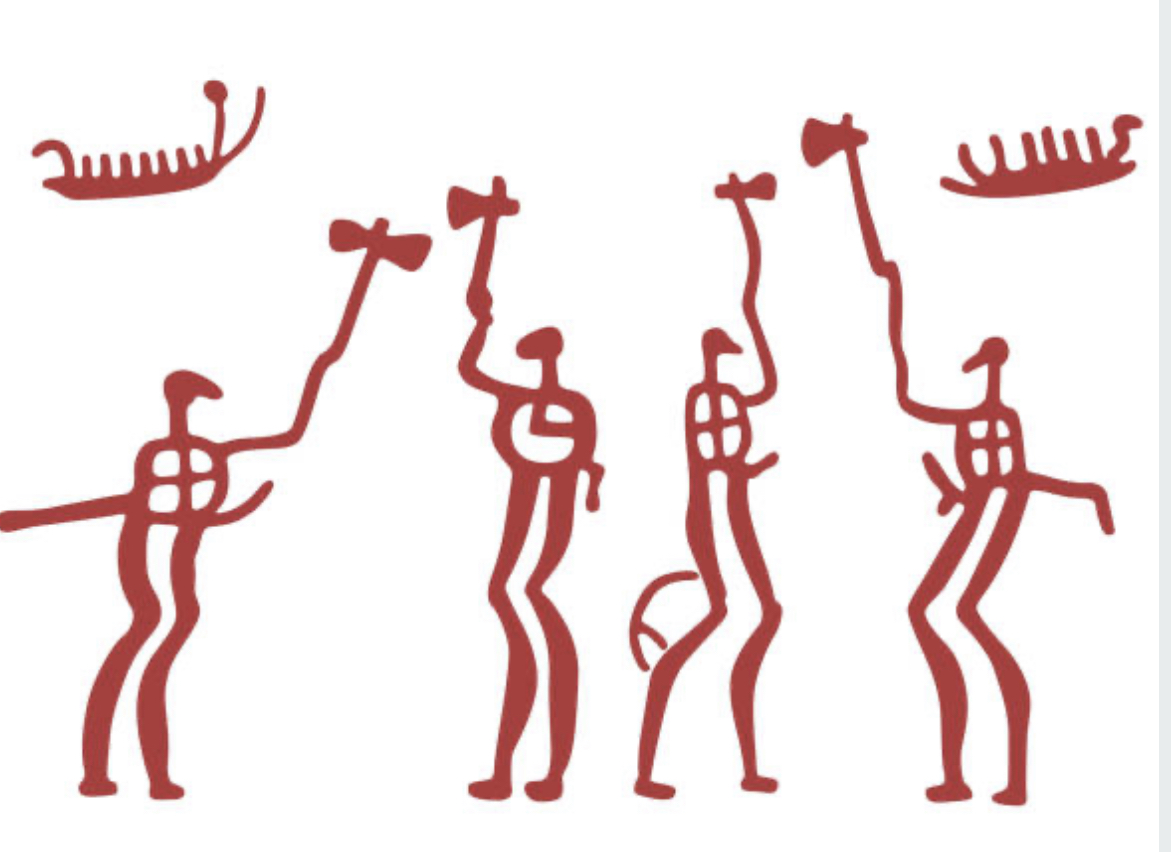
Groups of people created clans and tribes. If and when food sources became scarce for whatever reason such as drought or disease, these tribes would make war upon one another. We are mistaken to believe that war is a product of civilization, but rather it is seemingly endemic to human kind. The reproduction of humanity, encouraged by the high mortality rate of prehistoric life resulted in more mouths to feed, and more members of a tribe meant that it would grow and become stronger, thus more effective at the hunt and in waging warfare against competing tribes who laid claim to fishing and hunting areas and, with the beginnings of animal husbandry, grazing land. Procuring food for survival was on par in importance with procuring security for the tribe and the clan. These are the foundations of the city state or the kingdom. The images of people engaged in battle, or tribe members armed with weapons became a style and a genre unto itself, thus giving birth to heroic art. In this art we get an idea of how these primitive peoples waged war with one another. 


       Does the appearance of animals imply a battle unfolding over grazing land? 


     Warriors armed with axes, boats in the background, possibly depicting a maritime attack

We also know that the depiction  of war was an honored tradition, as was the creating of the hero-champion. The exploits of this hero-champion would be recounted at the central fire where the members of the clan would gather to hear their stories, sing songs and dance in their honor and please the deities of the sky and Earth with supplication and praise. Individuals, their names lost to history, nonetheless are depicted with an accent on the muscular, perfected human form brandishing their weapons sometimes standing among their peers in what would later develop into the statuary of the Assyrian kings or the pharaohs of Egypt, the sculptures of the gods that would adorn the temples of India or the realistic reproduction of heroes and deities in the art of Greece and Rome. All the elements and aspects of heroism and action that we witness in classical ancient or later medieval heroic or epic art can be found among the cave paintings and petroglyphs of the prehistoric world. Thus it might be said that we are not so different from our ancestors, perhaps only advanced in technology. Yes, we have developed certain understandings about morality and ethics and most of us hope we can one day rid ourselves of war. But on the other hand, what if this is who and what we are? Whenever a danger presents itself to any society, the image of the hero is conjured, sought and replicated so as to reassure the inhabitants of a nation, like the image of the champion was sought to reassure the tribe in  times of danger and stress. Though we might live more comfortably and securely today, the art of the hero and the image of war still fascinates us as it did in the times when our ancestors dwelled in a more insecure era. The question remains as to whether we as a race and a species are naturally prone to make war and accept it as the norm. Perhaps as long as mankind perceives war as a necessity, we will continue to create art that reflects this reality. 


Tadraut Acaceus Cave Painting    Libya  12,000 BC

Copyright Ismail Butera, 2023


The Lost Continent Of Kumari Kandam

There are many ancient accounts of lost continents and mythical kingdoms that have stirred the imagination of ancient bards and modern story...